




Archives
now browsing by author
What Can We Expect From the New Cambodian Prime Minister Hun Manet?
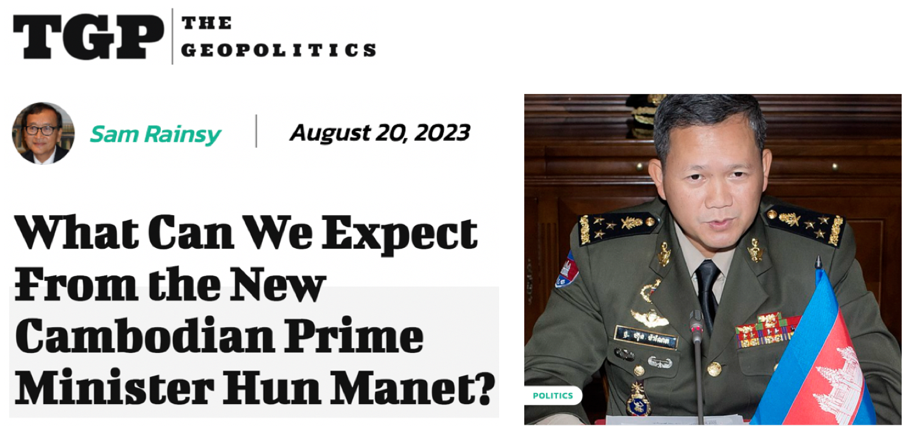
The Geopolitics
August 20, 2023
What Can We Expect From the New Cambodian Prime Minister Hun Manet?
By Sam Rainsy
Cambodia will have a new prime minister on August 22 in the person of Hun Manet, who will replace his father Hun Sen. This change has been orchestrated by Hun Sen himself after his 38-year rule, matching by only two African dictators.
Hun Manet’s assumption of office holds mostly symbolic value, as no significant changes in the political landscape of Cambodia are anticipated. In reality, Hun Sen will continue to pull the strings as the head of the Cambodian People’s Party (CPP), a party of communist origin that has been in power since 1979. Little will truly change as long as the current system established by Hun Sen himself remains intact. Hun Manet will effectively be a captive of this system, which he must preserve under the watchful eye of his father.
Neo-Khmer Rouge Regime
Hun Sen’s regime can be characterized as a neo-Khmer Rouge regime, as it is based on violence and impunity, much like under Pol Pot. Hun Sen was a loyal military leader under Pol Pot from 1975 to 1977. Under Hun Sen, at every level of the state, many new Cambodian leaders after Pol Pot were recruited from former Khmer Rouge cadres, allowing for the maintenance of a police state to this day.
What Hun Sen primarily expects from his son, Hun Manet, is the assurance of continued impunity. It’s widely known that in Phnom Penh, the courts are under political control, and none of the numerous political crimes – resembling acts of state terrorism – which have been committed under Hun Sen have ever been subject to a serious investigation. Cambodia is a land of impunity where the worst murderers roam freely within the corridors of state.
A glimmer of hope for an end to this impunity recently emerged from Paris. On 30 December, 2021, a French investigating judge’s ordinance hinted that Hun Sen could be prosecuted in France once he loses his judicial immunity tied to his role as head of government. This would be in relation to the grenade attack in Phnom Penh on 30 March, 1997. As a French citizen, I had filed a complaint against Hun Sen in the Paris court for an assassination attempt against me that resulted in at least 16 deaths among my supporters on that day.
Hun Sen’s second objective in passing the power from father to son is the ability to continue to control Cambodia both economically and in patrimonial terms.
The Cambodian economy is largely controlled by the Hun Sen family and its allies, forming a political and financial elite which holds immense wealth amidst widespread poverty. Hun Sen perpetuated the Khmer Rouge mentality and culture of considering the nation’s wealth and state property as spoils of war to be used at the victors’ discretion.
In this patrimonial power perspective, Hun Sen publicly declared that he saw himself in the future as “not only the father but also the grandfather of prime ministers.” He must have had the North Korean lineage of Kim Il-sung, Kim Jong-il and Kim Jong-un in mind.
Clan Succession
The replacement of Hun Sen by his son Hun Manet becomes almost comical when such succession extends not only to the Hun family but also to all families forming the ruling clan. In fact, practically all ministers in the current government led by Hun Sen will be replaced by their respective children in the upcoming government led by Hun Manet. This is a world-first that even North Korea had not dared to imagine.
What makes the creation of the Hun dynasty in Cambodia even more farcical is the “democratic” foundation that Hun Sen wanted to ensure for it. A two-penny farce that would be amusing if a country’s fate was not at stake.
Hun Sen wanted to take no risks over his son’s enthronement. On 23 July, he organized a sham election where his victory was 100% guaranteed. Just a few weeks before the voting day, he had arbitrarily removed the only opposition party that could have challenged him, the Candlelight Party (CP), which I founded 25 years ago.
This highly undemocratic and discriminatory measure provoked an outcry from the international community, which Hun Sen, in his determination to secure his son Hun Manet’s appointment as prime minister, utterly disregarded. But he won’t be able to ignore the backlash for long. Lack of legitimacy is the automatic result of elections without risk.
Lack of Legitimacy
This lack of legitimacy will remain a stain that forever marks the new government under Hun Manet.
Hun Manet himself has a lack of achievement for which Hun Sen cannot compensate. His personality seems rather dull compared to his father’s; he lacks charisma, eloquence and authority. Over the past twenty years spent alongside his father leading the country, particularly the military, he has never done or said anything that would suggest he possesses an independent personality. He has only continually praised his father without any critical thinking.
Despite being 45 years old, he has no known notable achievements or accomplishments, even though he had all the means to accomplish them. Just recently, when the time came to make him prime minister, slightly altering the initial timeline (see “What Lies Behind the Sudden Resignation of Prime Minister Hun Sen?” in The Geopolitics on August 7, 2023), “achievements” were suddenly attributed to him, such as his “heroic behavior” during border incidents with Thailand and Laos 10 or 15 years ago and his “exemplary leadership” in the fight against the Covid-19 pandemic.
These “achievements” largely rely on imagination, as some border incidents with neighboring countries were periodically manufactured by Hun Sen to boost his electoral campaigns, and the successes in fighting Covid-19 in Cambodia can raise skepticism (see “Cambodia is being turned into a political advert for Chinese vaccines” in The Geopolitics on November 16, 2021). Laos, which made little fuss about the pandemic, has fared better than Cambodia with fewer Covid-19 deaths per million inhabitants.
Even the highly-touted admission of Hun Manet to the US Military Academy at West Point conceals a secret inadvertently revealed by Hun Sen. In 2021, the father published a lengthy letter from his son in which the latter clarified that there were two paths to admission at West Point – one for Americans and the other for foreigners – and that he (Hun Manet) was admitted through the second path only thanks to political connections provided by the Phnom Penh government.
Looking ahead, with Hun Manet as prime minister and Hun Sen continuing to set the government’s major political directions, no liberalization of the current regime should be expected. This regime is fundamentally built on repression and violence, which have ensnared those exercising power. In fact, violence confines those who employ it to stay in power more so than those who suffer it. Any liberalization by dictators who rely on violence can only lead to their downfall. The enduring North Korean model is evidence of this.
Original source: https://thegeopolitics.com/what-can-we-expect-from-the-new-cambodian-prime-minister-hun-manet/
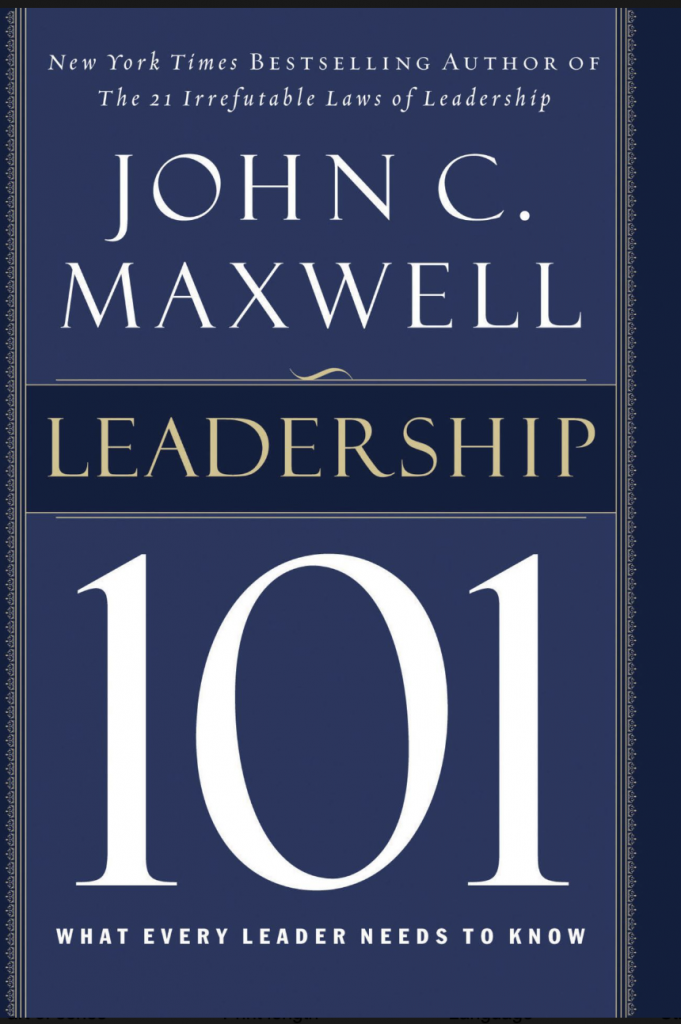
John C. Maxwell, Leadership 101: What Every Leader Needs to Know
Summary: Leadership 101 (John C. Maxwell)
Source By Admin

Leadership is one of those topics that makes me uneasy, only because it seems to attract charlatans, especially within the corporate world. That’s why the word has some negative connotations to it, at least in my mind. But there is nothing mysterious or negative about true leadership.
Author John C. Maxwell proves this with his refreshing book, Leadership 101. While the title of the book does sound basic and unoriginal, the content of the book is surprisingly strong. It covers the topic of leadership — within the context of an organization — in a very clear and concise manner.
By taking the most powerful excerpts and quotes from the book, which is already a concise volume, I find that the knowledge can be refreshed, and thus retained, in a fraction of the time it would take to re-read the book in its entirety. Below is my personal summary.
~
Did you know that each of us influences at least ten thousand other people during our lifetime? So the question is not whether you influence someone, but how will you use your influence.
Sir Francis Bacon observed that knowledge is power. Back when he lived and information was scarce, that may have been true. But today, it would be better to say that knowledge empowers — as long as it’s what you need.
PART 1: THE DEVELOPMENT OF A LEADER
Why Should I Grow As A Leader?
Leadership ability is the lid that determines a person’s level of effectiveness.
Your leadership ability — for better or for worse — always determines your effectiveness and the potential impact of your organization.
The higher you want to climb, the more you need leadership. The greater the impact you want to make, the greater your influence needs to be.

Leadership has a multiplying effect.

To change the direction of the organization, change the leader.
To reach the highest level of effectiveness, you need to raise the lid of leadership ability.
How Can I Grow As A Leader?
Leadership develops daily, not in a day.
What matters most is what you do day by day over the long haul.
“The secret of our success is found in our daily agenda.”
Leadership is complicated. It has many facets: respect, experience, emotional strength, people skills, discipline, vision, momentum, timing — the list goes on.
Leadership is influence.
The Four Phases of Leadership Growth:
- Phase 1: I don’t know what I don’t know
- Phase 2: I know what I don’t know
- Phase 3: I grow and know and it starts to show
- Phase 4: I simply go because of what I know
To be conscious that you are ignorant of the facts is a great step to knowledge.”
-Benjamin Disraeli
Successful leaders are learners. And the learning process is ongoing, a result of self-discipline and perseverance.
Whenever you come across a golden nugget of truth or a significant quote, file it away for the future.
There is an old saying: Champions don’t become champions in the ring — they are merely recognized there.
If you want to see where someone develops into a champion, look at his daily routine.
Boxing is a good analogy for leadership because it is all about daily preparation.
Leadership doesn’t develop in a day. It takes a lifetime.
PART 2: THE TRAITS OF A LEADER
How Can I Become Disciplined?
The first person you lead is you.
No matter how gifted a leader is, his gifts will never reach their maximum potential without the application of self-discipline.
Self-discipline: No one achieves and sustains success without it.
A Disciplined Direction:
- Challenge your excuses
- Remove rewards until the job is done
- Stay focused on results
If you lack self-discipline, you may be in the habit of having dessert before eating your vegetables.
If you know you have talent, and you’ve seen a lot of motion but little concrete results — you may lack self-discipline.
Look at last week’s schedule. How much of your time did you devote to regular, disciplined activities?
How Should I Prioritize My Life?
The discipline to prioritize and the ability to work toward a stated goal are essential to a leader’s success.
Success can be defined as the progressive realization of a predetermined goal.
Twenty percent of your priorities will give you 80 percent of your production.
Examples of Pareto principle:
- Time: 20 percent of our time produces 80 percent of the results.
- Counseling: 20 percent of the people take up 80 percent of our time.
- Products: 20 percent of the products bring in 80 percent of the profit.
- Reading: 20 percent of the book contains 80 percent of the content.
- Job: 20 percent of our work gives us 80 percent of our satisfaction.
- Speech: 20 percent of the presentation produces 80 percent of the impact.
- Leadership: 20 percent of the people will make 80 percent of the decisions.
- Business: 20 percent of the people in an organization will be responsible for 80 percent of the company’s success.
- Determine which people are the top 20 percent producers.
- Spend 80 percent of your “people time” with the top 20 percent.
- Spend 80 percent of your personal development dollars on the top 20 percent.
- Determine what 20 percent of the work gives 80 percent of the return and train an assistant to do the 80 percent less-effective work.
- Ask the top 20 percent to do on-the-job training for the next 20 percent.
Remember: We teach what we know; we reproduce what we are. Like begets like.
If this person takes a negative action against me or withdraws his or her support from me, what will the impact likely be? If you won’t be able to function, then put a check mark next to that name.
Remember: It’s not how hard you work; it’s how smart you work.
The ability to juggle three or four high priority projects successfully is a must for every leader.
A life in which anything goes will ultimately be a life in which nothing goes.
Leaders:
- Initiate
- Lead: pick up the phone and make contact
- Spend time planning: anticipate problems
- Invest time with people
- Fill the calendar by priorities
Followers:
- React
- Listen; wait for phone to ring
- Spend time living day-to-day reacting to problems
- Spend time with people
- Fill the calendar by requests
What is required of me?
What gives me the greatest return?
Am I doing what I do best and receiving a good return for the organization?
What is most rewarding?
មេដឹកនាំត្រូវប្រកបដោយព្រហ្មវិហារធម៍៤
ការបង្រៀនរបស់ព្រះពុទ្ធជាម្ចាស់ ប្រពៃណីជំនឿខ្មែរ និងសិល្បះប្រាសាទនានា អំពីព្រហ្មវិហារធម៌៤គឺល្អ ចុះហេតុអ្វីមេដឹកនាំនិងប្រជារាស្ត្រខ្មែរនៅមានខ្វះចន្លោះច្រេីន៖
- ១ ការអប់រំរៀនសូត្រ
- ២ កំសោយការអនុវត្តច្បាប់
- ៣ ផ្នត់គំនិត
- ៤ តុលាការបាត់បង់ជំនឿទុកចិត្តពីប្រជាពលរដ្ឋ
អ្នកដឹកនាំល្អគឺជាអ្នកតាមល្អ

ប្រសិទ្ធភាពមេដឹកនាំគឺជាអ្នកតាមដ៏ឆ្នេីមម្នាក់