

| The January 7 celebrations in context
Written by Sophan Seng |
|
| Wednesday, 07 January 2009 | |
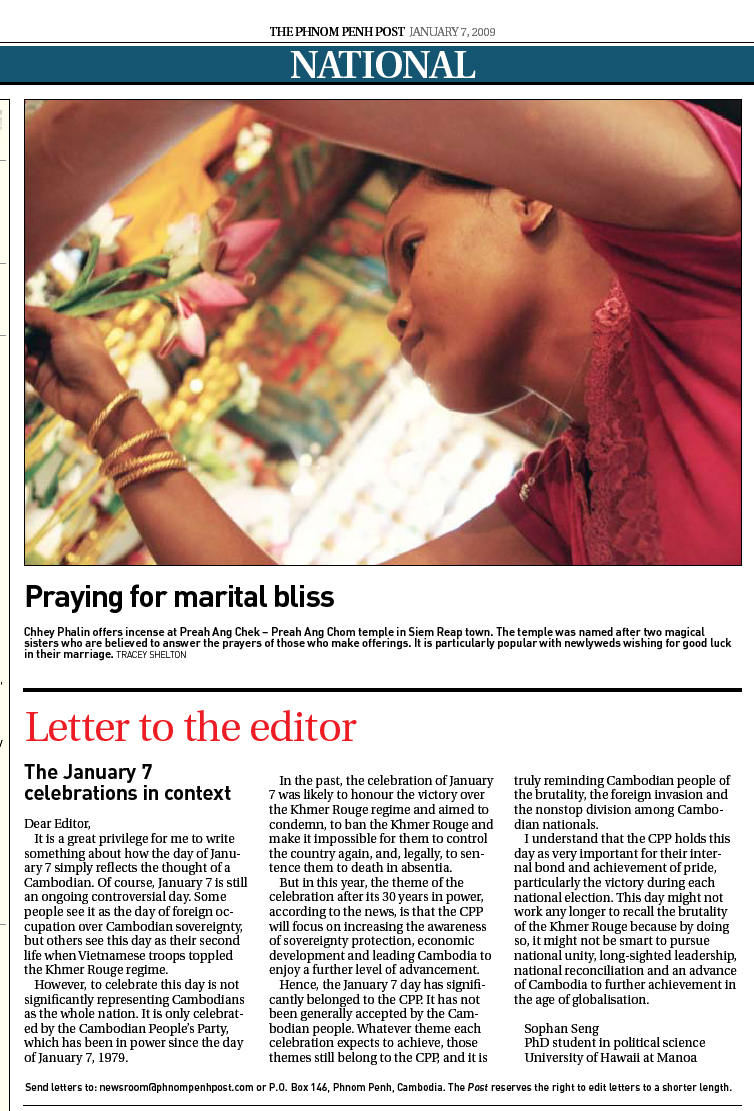
Dear Editor, It is a great privilege for me to write something about how the day of January 7 simply reflects the thought of a Cambodian. Of course, January 7 is still an ongoing controversial day. Some people see it as the day of foreign occupation over Cambodian sovereignty, but others see this day as their second life when Vietnamese troops toppled the Khmer Rouge regime. However, to celebrate this day is not significantly representing Cambodians as the whole nation. It is only celebrated by the Cambodian People’s Party, which has been in power since the day of January 7, 1979. In the past, the celebration of January 7 was likely to honour the victory over the Khmer Rouge regime and aimed to condemn, to ban the Khmer Rouge and make it impossible for them to control the country again, and, legally, to sentence them to death in absentia. But in this year, the theme of the celebration after its 30 years in power, according to the news, is that the CPP will focus on increasing the awareness of sovereignty protection, economic development and leading Cambodia to enjoy a further level of advancement. |
Category Archives: Education
Change can’t occur without action
PACIFIC DAILY NEWS
December 31, 2008
Change can’t occur without action
A. Gaffar Peang-Meth, Ph.D.
The year’s last day. Tomorrow we will awaken to the new year, 2009!
There were many things “wrong” with 2008. But no amount of money, no volume of words, no mountain of compassion can change what has occurred. We can learn from the past, but we mustn’t live there. A Sanskrit proverb says, “Yesterday is but a dream” and “tomorrow is only a vision.”
Tomorrow, the first day of the new, and hopefully with heaven’s help, improved 2009, will be upon us. It is we, with our qualities and frailties, who will or won’t make 2009 a different year. We can only ask God for help.
Many of us have compiled the annual list of New Year’s resolutions. Most of those are probably familiar commitments, recycled from past years’ versions.
The French say, “Man proposes, God disposes.” But humans tend to talk the talk but not walk the talk, to want something but not make steps to attain it with serious commitment, consistency and perseverance.
German-born American physicist Albert Einstein reminded, “Information is not knowledge,” and German playwright Johann von Goethe posited, “Knowing is not enough; we must apply. Willing is not enough; we must do.”
And Asia’s great thinker, Confucius, said, “Real knowledge is to know the extent of one’s ignorance,” and “No matter how busy you may think you are, you must find some time for reading, or surrender yourself to self-chosen ignorance.”
Reflect on the good and positive
PACIFIC DAILY NEWS
December 24, 2008
Reflect on the good and positive
A. Gaffar Peang-Meth, Ph.D.
If you didn’t pay attention to the findings published in the British Medical Journal earlier this month — noted in my column last week — happiness is contagious; if you are connected to unhappy people, this is likely to increase your chances of being unhappy by about seven percent, on average.
Since smiling, singing and laughter tune up the positive emotions of the people near and around you, you can make this season the “most wonderful time of the year,” as the song goes.
The holiday season is also a time of reflection. Every year I replay memories of the past, near and distant. I sigh at some, shake my head at some, smile at some. And I remember the wise counsel: “Learn from the past, but don’t live there!”
I give thanks to all that happened, the good and the not-so-good — from the not-so-good I learned the good. And I follow the wise counsel: “Live life rather than let life live you.” Make life what I would like it to be; take ownership of my actions rather than blame or praise karma.
I dust off writings by Indian philosopher Jiddu Krishnamurti (1895-1986) who teaches that we can live “sanely, happily, intelligently,” even in a world of conflicts inside ourselves and a world of frictions outside, at work, in the community, or in the world, by living the present “in goodness.”
Continue reading
Why education is the only answer to Cambodia’s problems
| Working for Cambodia’s future |
| Written by SOVACHANA POU | |
| Wednesday, 19 November 2008 | |
Why education is the only answer to Cambodia’s problems

Photo by: SOVACHANA POU
Cambodian students at Phnom Penh’s Wat Ounalum. LIFE is calling. Cambodia is calling. Being back home makes me think in a different perspective. I feel as an outsider stepping into, and an insider stepping out of, the same country. I look forward to contributing to the educational wealth of my beloved country through teaching. I am at the stage of my life where my primary goal is to help develop the younger generation to lead useful lives for the benefit of human kind. I feel my work has just begun. As any patriotic Cambodian, I am proud of my heritage and my tradition. After many wars, our country and our people suffered enormously and faced many setbacks, such as deep-rooted mistrust, Khmer killing Khmer, grinding poverty, injustice, greed, corruption, land grabbing, nepotism, a culture of impunity, oppression of thoughts and actions, fear, destruction of our natural resources, safety, security, education, lack of respect of the rules of laws, etc. Poverty is rampant all over the world, but there is nothing like being poor in Cambodia. It is very fashionable to talk about the poor so the top leaders can get more foreign aid. Unfortunately, it is not fashionable to talk with the poor to find out the reality of their sufferings. The environment most Cambodians are living in now is hurting the next generation. We have lost many traditional values. The reality is Cambodia is still a very poor country, plagued by uncertainties and a mess of contradictions. I don’t have all the answers to the complex problems. I am far from perfect, but as a teacher I learned early that I can’t fix everything but can help most things. I know I cannot offer material goods or gifts to the children but I always can offer pieces of my love through teaching and learning. I cannot erase all the dark sides of the current government, but I can change the way I deal with it. I can rise above it and stay strong and true to myself by applying the teachings of Buddha: “abstain from all unwholesome deeds or do not engage in any harmful actions; always perform only wholesome ones, those that are good, subdue and purify your own mind”. By practicing Sila (morality) and following the five precepts (refrain from killing, stealing, telling lies, all intoxicants and immoral sexual activity) I can inspire others to think and act with integrity and vision for a sustainable and just society. |