An analysis on Cambodia politics: old tactician is facing with new pragmatic politicians in Cambodia and those pragmatic younger generations.

 Posted in Culture, Economics, Education, KR Trial, Leadership, Politics, Researches, Social
An analysis on Cambodia politics: old tactician is facing with new pragmatic politicians in Cambodia and those pragmatic younger generations.
I wrote that CNRP lawmakers must work hard on behalf of the many who voted them in office and keep the electorate and members of the international community abreast of their efforts. The people and the world would know who engaged in malice. I raised my frustration over CNRP leaders’ anti-Vietnamese rhetoric and appeals to emotionalism, urging statesman-like behavior to make themselves a credible alternative to the CPP.
In the July 2013 elections:with 9.67 million eligible voters and 6.62 million votes cast (68% voter turnout), a reported 3.2 million votes (48.8%) were cast for Hun Sen/CPP despite alleged fraud, and a reported 2.9 million votes (44.4%) went to the CNRP, providing no overwhelming victory for the ruling party. The Premier and his CPP had heaven to thank for the competing half dozen parties that collectively received a half million votes, theoretically more than enough to have won the election for the opposition CNRP had the smaller parties not competed.
FOR PUBLICATION
AHRC-ETC-002-2015
January 15, 2015
 An article by Dr. Gaffar Peang-Meth published by the Asian Human Rights Commission
CAMBODIA: Some Thoughts for 2015
I begin this New Year 2015 with a renewed reminder: It is less what we know, but more how we think, that determines the quality of our life and our future.
We must imagine, explore, and challenge what we believe we know. That is how we improve ourselves and our circumstances.
Reality and the little buddhas?
Journalist and author Elizabeth Becker mirrored a common affirmation when she observed, “To be Cambodian is to be Buddhist.” Most Cambodians would agree. Lord Gautama Buddha (563 BC-483 BC) teaches to do all good, avoid all evil, and purify the mind (through meditation). Yet, look around. Among relatively intelligent friends, siblings, and relatives; at offices; between neighbors; among members of communities and nations, there’s a world of friction and disharmony, disorder and discontent.
Many talk the talk – they go to Temple, recite memorized religious teachings – but are less consistent in their actions. Buddha counsels, “However many holy words you read, however many you speak, what good will they do if you do not act upon them?”
This part you shall essentially learn about good leaders must be equipped by Four Sublime State of the Mind ie. Loving-kindness, compassion, sympathy, and equanimity.
Posted in Culture, Economics, Education, Environment, KR Trial, Leadership, Politics, Researches, Social, Tourism
Comment: as for the food of thought, article here is taken from History and the Headlines and photos here are taken from Maha Phirum Facebook and many paper works to reflect on this day at the middle.
Cambodia, Vietnamese Occupation of (1978–1992)
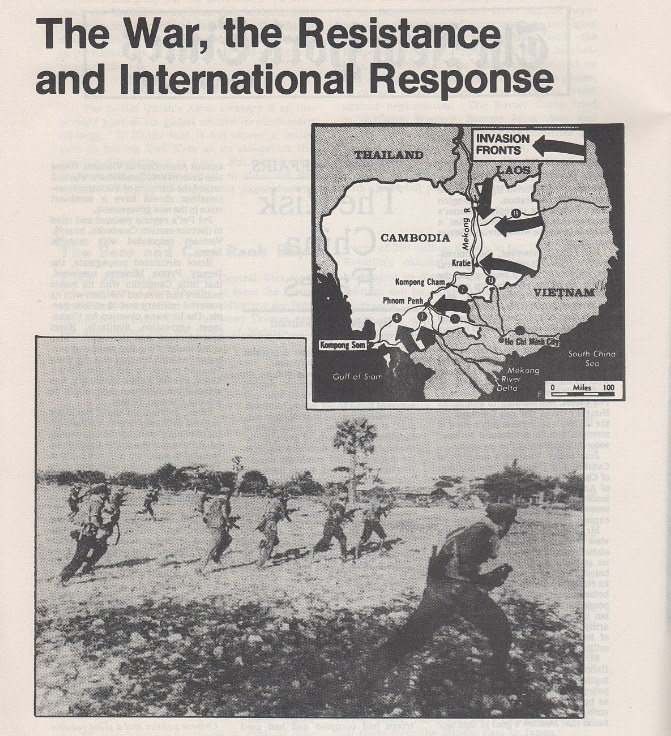 On 25 December 1978, Vietnamese armed forces invaded Cambodia, ushering in an occupation lasting nearly thirteen years. This incursion marked the first and only extended war between communist regimes and led to a brief but bloody border war between Vietnam and the People’s Republic of China (PRC). Moreover, the occupation added to the tremendous suffering that Cambodia endured during the Cold War and greatly affected Southeast Asia.The origins of the Vietnamese-Cambodian conflict are complex and reach far back into history. The Vietnamese and Khmer (Cambodian) Empires had been bitter rivals for centuries. By the early 1800s, much of Cambodia had come under Vietnamese rule or was forced to pay tribute to it. This gave rise to deep-seated animosities that survived decades of French colonial rule, Japanese occupation during World War II, and two Indochinese conflicts spanning nearly thirty years.
Some interesting documentaries:
1. Vietnamese invasion in 1979
2. Interviewing Mr. Buy Teen, a former Vietnamese high ranking military staff in Cambodia on “Why Vietnam Withdrew troops from Cambodia?”
Continue reading